Institutional Momentum Builds as JPMorgan Evaluates Its Own Stablecoin
One of the most significant headlines crossing the wire this week comes from Bloomberg sources indicating that JPMorgan Chase recently evaluated launching its own stablecoin. While the bank has long maintained a complicated relationship with crypto — from Jamie Dimon's early skepticism to the quiet launch of JPM Coin for internal settlement — a consumer or market-facing stablecoin would represent a meaningful shift in posture from one of the world's largest financial institutions.
The timing is notable. Stablecoin legislation in the United States has been advancing through Congress, and major payment networks are increasingly positioning themselves around dollar-pegged digital assets. A JPMorgan stablecoin would enter a market already occupied by Tether and Circle, but with the distribution muscle of a global bank behind it. No formal announcement has been made, and the evaluation may not result in a product — but the fact that the conversation is happening internally signals where institutional attention is focused heading into late 2026.
Charles Schwab to Offer SOL, AVAX, and LINK to Crypto Clients
Charles Schwab announced this week that its crypto clients will soon be able to buy and sell Solana (SOL), Avalanche (AVAX), and Chainlink (LINK) directly through the platform. This expansion goes beyond Bitcoin and Ethereum, marking a notable step for one of the largest retail brokerage platforms in the United States.
The addition of Chainlink is particularly interesting given its role in oracle infrastructure — it's not the most obvious choice for a mainstream retail offering, suggesting Schwab's product team is thinking carefully about utility-layer assets rather than just headline names. Avalanche, with a market cap around $3.2 billion, and Chainlink round out what is a more sophisticated asset menu than many traditional brokerages currently offer. For the broader altcoin market, Schwab-level distribution access has historically been a meaningful demand signal.
LayerZero Launches a New Exchange in Partnership with Citadel Securities and DTCC
In what could prove to be one of the more structurally significant developments of the month, LayerZero — the omnichain interoperability protocol — has launched a new exchange, reportedly in a partnership involving Citadel Securities and the DTCC (Depository Trust & Clearing Corporation). LayerZero's native token ZRO carries a market cap of approximately $738 million at the time of writing.
The involvement of DTCC, which processes the vast majority of securities transactions in the United States, alongside Citadel Securities as a market-making powerhouse, suggests this is not a speculative retail-facing venue. The combination of cross-chain infrastructure with institutional settlement rails points toward a platform designed for serious capital. Details remain sparse, but the institutional pedigree of the partners alone makes this worth watching closely.
Binance Futures Adds Traditional Finance Perpetual Contracts
Binance announced the upcoming launch of multiple USDT-margined perpetual contracts tied to traditional finance assets. The move continues a trend of crypto derivatives exchanges broadening their product scope to include equity indices, commodities, and other TradFi-adjacent instruments — bringing speculative exposure to traditional markets into a crypto-native trading environment.
This is a competitive response to growing demand from traders who want unified margin accounts spanning both crypto and macro assets. It also reflects the blurring line between crypto exchanges and broader financial platforms — a theme that runs through much of this week's news.
Upbit Lists PolySwarm (NCT) on KRW Market
South Korean exchange Upbit added PolySwarm (NCT) to its KRW market. NCT has a relatively modest market cap of around $12.4 million, making this a smaller-cap listing. Korean exchange listings have historically generated short-term volume spikes due to the retail-heavy nature of the market, so NCT is worth monitoring for near-term volatility even if the fundamental thesis remains niche. PolySwarm operates as a decentralized threat intelligence marketplace — a specialized use case that has kept it below mainstream radar.
Trending Tokens: From Memecoins to Tokenized Equities
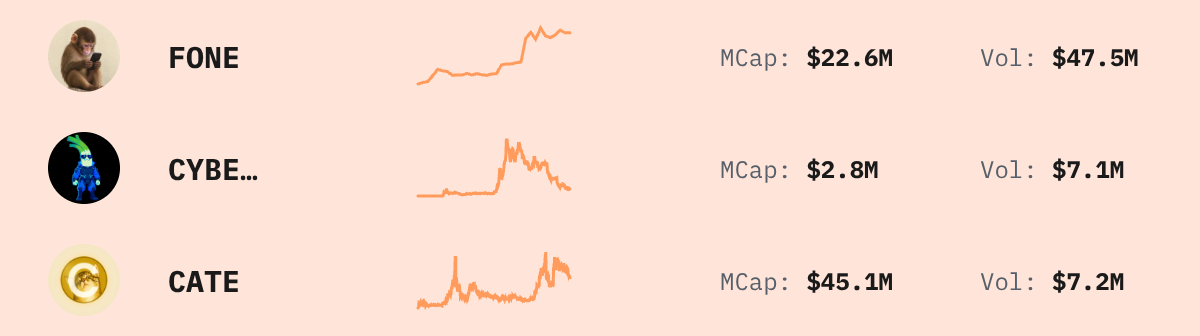
On the trending front, Base chain is seeing activity around NVIDIA Corporation — a tokenized or synthetic representation of the equity — alongside Coinbase Wrapped BTC. The presence of a tokenized NVIDIA on Base reflects growing interest in bringing equity exposure on-chain, a trend that's accelerating as regulatory clarity improves. On BNB Smart Chain, ShopinX Token is drawing attention, while Solana's trending list skews toward newer, lower-cap launches including apeonfone and CyberLeek.
Outlook
The dominant theme across today's data is institutional infrastructure build-out. JPMorgan exploring a stablecoin, DTCC involved in a LayerZero exchange, Schwab expanding its crypto asset menu, and Binance bridging TradFi derivatives — these are not isolated events. They form a consistent picture of traditional finance deepening its commitment to digital asset rails in 2026. Near-term price action aside, the structural story remains one of expanding access and integration. Traders and observers alike should track the LayerZero exchange launch details as they emerge — the institutional names involved make it a potentially market-moving development.