Institutional Momentum Builds as JPMorgan Eyes Its Own Stablecoin
The most consequential headline crossing the wire this week comes from Bloomberg, which reports that JPMorgan Chase has recently evaluated pursuing its own stablecoin. While the bank stopped short of a formal announcement, the mere fact that one of the world's largest financial institutions is conducting internal feasibility work on a dollar-pegged digital asset underscores just how seriously traditional finance is now treating blockchain-based payment rails. JPMorgan already operates JPM Coin for institutional wholesale transfers, but a retail-facing or broader stablecoin product would represent a significant escalation in the bank's on-chain ambitions — and would place it in direct competition with USDT and USDC in a way its current infrastructure does not.
Charles Schwab Opens Crypto Doors to SOL, AVAX, and LINK
In another sign of deepening mainstream adoption, Charles Schwab has announced that its crypto clients will soon be able to trade Solana (SOL), Avalanche (AVAX), and Chainlink (LINK) directly through its platform. Schwab, which manages trillions in client assets, adding these three tokens to its offering is not a trivial event. Avalanche currently carries a market cap of approximately $3.2 billion, and the inclusion of Chainlink — a critical piece of decentralised oracle infrastructure — alongside two Layer 1 networks signals that Schwab is moving beyond Bitcoin and Ethereum to offer clients meaningful exposure to the broader ecosystem. For retail investors who manage their portfolios through Schwab's interface, this reduces the friction of accessing altcoin exposure considerably.
LayerZero Launches Exchange as Citadel Securities and DTCC Partner
The omnichain interoperability protocol LayerZero has launched a new exchange, with the launch coinciding with a reported partnership between Citadel Securities and the DTCC to expand institutional market infrastructure for digital assets. LayerZero's native token ZRO currently holds a market cap of approximately $738.3 million, making it a mid-cap protocol with significant name recognition in the cross-chain space. The combination of a new trading venue from LayerZero and institutional-grade infrastructure partnerships between Citadel and DTCC suggests a continued push to build out the plumbing that professional market participants require before committing larger capital to digital asset markets.
Upbit Lists PolySwarm (NCT) and EURC
South Korea's leading exchange Upbit has made two notable additions this week. PolySwarm (NCT), a decentralised threat intelligence marketplace, has been added to the KRW market. NCT carries a modest market cap of just $12.4 million, meaning the Upbit listing could have an outsized impact on price and liquidity relative to its current size — Korean exchange listings have historically generated sharp short-term volume spikes for smaller tokens.
Separately, Upbit has also listed EURC, Circle's euro-backed stablecoin, across KRW, BTC, and USDT market pairs. The addition of a euro stablecoin to one of Asia's largest exchanges is a noteworthy development for cross-border liquidity, particularly as regulatory clarity around stablecoins continues to improve in both European and Asian jurisdictions.
Trending Tokens to Watch
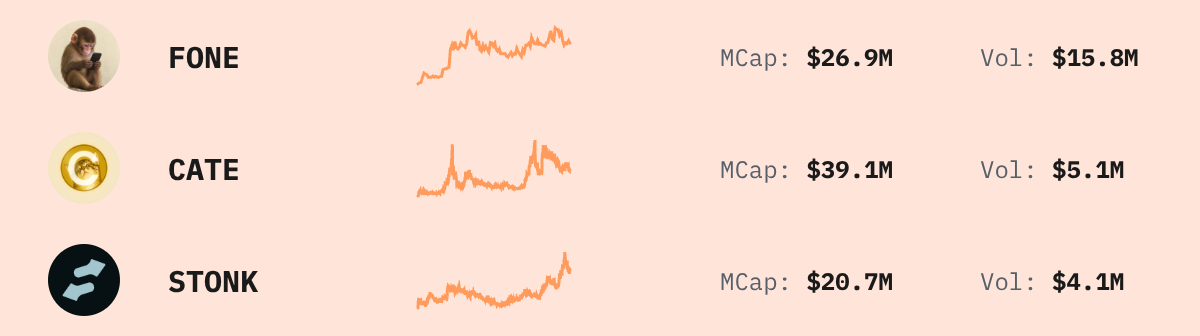
On the chain-level activity front, a handful of tokens are attracting attention across multiple ecosystems. On Base, Venice Token is generating interest — Venice is a privacy-focused AI inference platform, and its token has been building a following among users seeking decentralised alternatives to centralised AI services. On Ethereum, Programmable is trending, though volume data remains thin. On BNB Smart Chain, BTCB Token — the wrapped Bitcoin representation on BSC — is appearing in trending lists, which may reflect increased cross-chain activity or arbitrage flows rather than speculative interest in the token itself.
Outlook
With price data currently unavailable across major assets, the macro picture for crypto heading into the final day of August 2026 is being shaped more by narrative and institutional developments than by chart structure. The JPMorgan stablecoin evaluation, Schwab's expanded token offering, and the Citadel-DTCC-LayerZero convergence all point in the same direction: institutional infrastructure is accelerating, and the lines between traditional finance and digital assets are blurring faster than many anticipated. Whether these developments translate into sustained capital inflows will be the key question to watch as September — historically a volatile month for crypto markets — begins.