The Clarity Act Hits a Wall in the Senate
The most significant macro development for the crypto industry this week came from Washington: the Clarity Act failed to secure the 60 votes required to advance to the next legislative stage in the U.S. Senate. The bill, which had been positioned as a landmark framework for defining regulatory boundaries between the SEC and CFTC over digital assets, now faces an uncertain path forward. This is a notable setback for the industry, which has spent years lobbying for a clear legislative structure to govern token classification and exchange operations. Whether proponents attempt to rework the bill or push alternative legislation remains to be seen, but the vote signals that a comprehensive crypto regulatory framework in the U.S. is still not imminent.
SEC Approves Conditional Exemption for Tokenized Stock Trading On-Chain
In what amounts to a quietly significant regulatory development, the SEC approved a temporary conditional exemption allowing limited on-chain trading of tokenized stocks. The move represents one of the most concrete steps U.S. regulators have taken toward acknowledging blockchain-based securities infrastructure as a viable — if still tightly controlled — venue for traditional asset trading. The "limited" and "conditional" language suggests this is very much a pilot posture rather than a broad opening, but it marks a meaningful shift in how the Commission is engaging with on-chain finance. For projects operating at the intersection of DeFi and traditional markets, this is worth monitoring closely as guidance develops.
S&P Global to Acquire OpenZeppelin
In a striking signal of institutional convergence with the blockchain developer ecosystem, S&P Global announced an agreement to acquire OpenZeppelin, the widely used smart contract security firm behind some of the most foundational open-source libraries in Ethereum development. OpenZeppelin's auditing services and contract standards underpin a significant portion of deployed DeFi protocols and token contracts. The acquisition by one of the world's most prominent financial data and ratings companies suggests that blockchain infrastructure and security tooling are increasingly viewed as core components of the broader financial system — not fringe technology. Terms of the deal were not immediately disclosed.
Upbit Adds PYUSD and JPYC; Bithumb Lists AVA in KRW Market
On the exchange listing front, South Korean platform Upbit added trading support for PayPal USD (PYUSD) and JPYC, a yen-pegged stablecoin, across KRW, BTC, and USDT markets. The PYUSD listing on a major Korean exchange is notable given PayPal's broader push to expand stablecoin adoption across international markets. Separately, Bithumb added a Korean Won (KRW) market for AVA, the token associated with Travala, which carries a market cap of approximately $11.6 million at the time of listing — a relatively small-cap addition that underscores Bithumb's continued appetite for altcoin market expansion.
Trending Tokens: Pepe, Venice Token, and a Few Eyebrow-Raisers
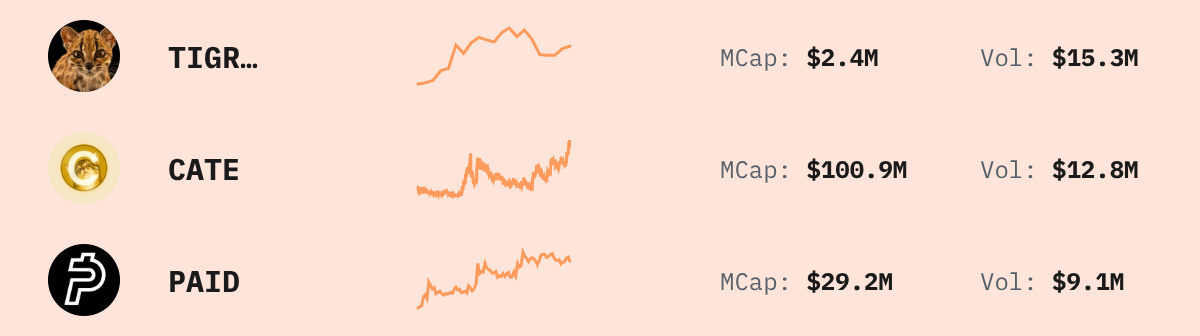
On the on-chain activity front, Pepe is registering trending activity on Ethereum, consistent with its pattern of periodic retail-driven volume surges. On Base, Venice Token and Derive are among the top trending assets, with Solana also appearing on the Base trending list — likely reflecting cross-chain narrative interest rather than a native Base token. On Solana itself, Leopardus Tilcayo — also appearing as a new token launch — and Catecoin are trending, both with effectively zero reported volume at the time of data capture, which typically signals early-stage memecoin activity that may or may not gain traction. Traders chasing these types of launches should be aware of the historically high failure and rug rates in this category.
Outlook
The failure of the Clarity Act removes a near-term catalyst that some had hoped would bring regulatory certainty to U.S.-based crypto businesses, and markets will likely digest that absence in the coming sessions. On the other hand, the SEC's tokenized stock exemption and the S&P Global–OpenZeppelin deal both point toward a longer-term trajectory of institutional integration with blockchain infrastructure. The regulatory picture remains fragmented, but the direction of institutional engagement continues to move toward deeper involvement rather than retreat. Upcoming sessions will likely see continued attention on stablecoin legislation as an alternative legislative vehicle, and any further SEC guidance on tokenized assets will be closely watched.