The Week's Defining Regulatory Moment: Clarity Act Stalls in Senate
The most consequential development for the crypto industry this week came not from price action, but from Capitol Hill. The Clarity Act failed to secure the 60 votes required to advance to its next legislative stage in the U.S. Senate. The bill, which had been positioned as a landmark framework for defining the regulatory treatment of digital assets — particularly the long-debated question of which tokens qualify as securities versus commodities — has now hit a significant procedural wall. The failure to reach cloture means the legislation returns to uncertainty, and market participants hoping for a clear regulatory roadmap will need to wait longer. This outcome is a notable setback for industry lobbying efforts that have intensified over the past two years.
SEC Greenlights On-Chain Tokenized Stock Trading
In what may be the most structurally significant regulatory news of the month, the U.S. Securities and Exchange Commission approved a temporary conditional exemption permitting the limited on-chain trading of tokenized stocks. The move represents a carefully scoped but historically meaningful step: for the first time, regulated tokenized equity instruments can trade on blockchain infrastructure under an official SEC framework, even if the exemption is bounded by conditions and a defined window.
This development lands at an interesting moment given the Clarity Act's failure. While Congress has struggled to define the rules, the SEC appears to be carving out its own incremental path via exemptive relief. The longer-term implications for traditional equities markets, DeFi protocols, and tokenization platforms are substantial, though the practical scope of what's permitted under the exemption will be closely scrutinized by legal teams across the industry.
S&P Global Acquires OpenZeppelin
In a deal that underscores how deeply traditional financial infrastructure is now integrating with blockchain tooling, S&P Global announced an agreement to acquire OpenZeppelin, the widely used smart contract security and auditing firm. OpenZeppelin's libraries and audit services underpin a vast portion of deployed Ethereum smart contracts, making it foundational infrastructure for DeFi, tokenization projects, and NFT platforms alike.
The acquisition signals that legacy data and ratings giants are moving beyond observation and into direct ownership of Web3 infrastructure. For developers, the key question will be how OpenZeppelin's open-source commitments and community relationships evolve under S&P Global's ownership. For the broader market, it reinforces the narrative that institutional adoption in 2026 is no longer limited to holding assets — it now includes acquiring the tools that build the ecosystem.
Exchange Listings: PYUSD and JPYC Land on Upbit
South Korean exchange Upbit added support for PayPal USD (PYUSD) and JPYC, the Japanese yen-pegged stablecoin, across KRW, BTC, and USDT markets. The PYUSD listing is particularly notable given PayPal's ongoing efforts to expand its stablecoin's footprint across both centralized and decentralized venues. Access to South Korea's highly active retail trading base could meaningfully expand PYUSD's transactional volume.
Meanwhile, Bithumb added a KRW market for AVA, the token associated with a project carrying a market cap of approximately $11.6 million at time of listing — a relatively small-cap addition that reflects Bithumb's continued appetite for diversifying its listed assets beyond top-tier tokens.
Trending on Ethereum: "Fake World Assets" and Zama Draw Attention
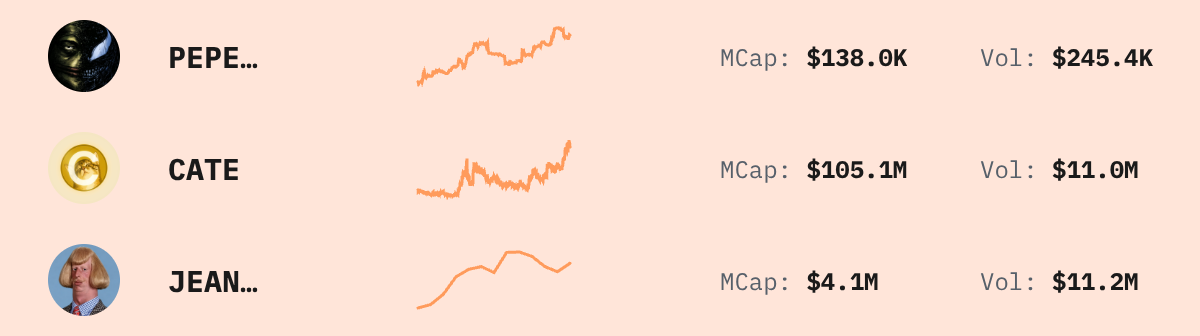
On the Ethereum network, three tokens surfaced as trending: Fake World Assets, Pepe, and Zama. The appearance of "Fake World Assets" is worth noting as a likely commentary — or parody — on the real-world asset (RWA) tokenization narrative that has dominated institutional crypto discourse through 2025 and into 2026. Zama, a cryptography-focused project working on fully homomorphic encryption for blockchain applications, continues to attract developer and speculator interest as privacy infrastructure gains renewed relevance.
Outlook
The dual headline of the Clarity Act's failure and the SEC's tokenized stock exemption defines the current regulatory moment well: formal legislative clarity remains elusive, yet regulatory agencies are moving forward with targeted, conditional permissions. The S&P Global–OpenZeppelin deal adds another data point to the ongoing institutionalization of crypto infrastructure. In the near term, attention will turn to how markets digest the Senate setback and whether the SEC's tokenized equity exemption attracts meaningful platform participation. The regulatory calendar remains the dominant force shaping sentiment, with price discovery likely to follow whatever clarity — or lack thereof — emerges from Washington in the weeks ahead.