Clarity Act Falls Short in the Senate
The headline dominating crypto policy circles today is the failure of the Clarity Act to advance past a procedural vote in the US Senate. The bill did not secure the 60 votes required to move to the next legislative stage, representing a significant setback for the industry's push to establish a clear regulatory framework distinguishing digital commodities from securities. The Clarity Act had been one of the more closely watched pieces of crypto legislation in recent years, aiming to resolve the long-running jurisdictional ambiguity between the SEC and CFTC. Its stalling does not kill the bill outright, but it does push meaningful regulatory clarity further down the road — a frustration for projects and institutions that have been waiting on defined rules before making larger commitments to US-based operations.
SEC Approves Limited On-Chain Trading of Tokenized Stocks
In a development that cuts somewhat against the regulatory gloom, the SEC has approved a temporary conditional exemption allowing limited on-chain trading of tokenized equities. While the scope remains narrow and the exemption is conditional, the move marks a notable shift in posture from the regulator. Tokenized stocks — blockchain-based representations of traditional equity shares — have long been discussed as a bridge between decentralized finance and conventional capital markets. A formal, if limited, green light from the SEC could accelerate institutional experimentation in this space. The details of which platforms qualify and what conditions apply will be critical to watch as they emerge.
S&P Global to Acquire OpenZeppelin
In what may prove to be one of the more consequential corporate moves in the blockchain infrastructure space this year, S&P Global has announced an agreement to acquire OpenZeppelin. OpenZeppelin is widely regarded as a cornerstone of smart contract security — its auditing services and open-source contract libraries underpin a substantial portion of the Ethereum ecosystem. S&P Global's interest signals that traditional financial data and ratings giants are moving beyond passive observation of crypto and into direct ownership of critical Web3 infrastructure. The implications for OpenZeppelin's open-source commitments and independent audit positioning will be worth monitoring closely.
Upbit Adds PYUSD and JPYC Trading Pairs
South Korean exchange Upbit has announced new trading support for PayPal USD (PYUSD) and JPYC, with pairs available across KRW, BTC, and USDT markets. The listing of PYUSD — PayPal's dollar-backed stablecoin — on one of Asia's largest exchanges by volume is a continued sign of the token's push for broader distribution beyond US-centric platforms. JPYC, a Japanese yen-pegged stablecoin, gaining traction on a major Korean exchange reflects growing regional interest in local-currency stable assets. Both listings landed on September 17th and may see early volume spikes as the market absorbs new liquidity.
Bithumb Lists AVA in KRW Market
Korean exchange Bithumb has added AVA to its Korean Won market, according to an official notice. AVA carries a reported market cap of approximately $11.6 million at time of listing — a relatively small-cap addition that nonetheless benefits from the visibility that a Bithumb KRW listing provides. Korean retail participation tends to move the needle on smaller assets, so AVA's price action in the days following the listing will be worth watching.
Trending: Venice Token, Zama, and Non-Playable Coin
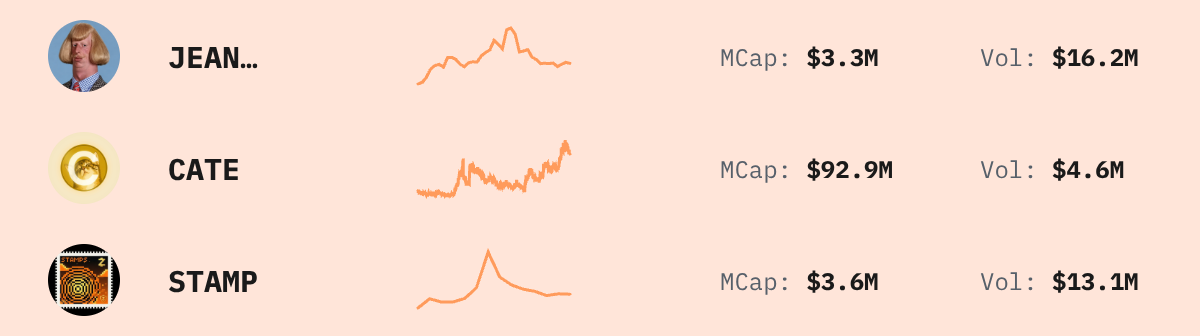
On the trending front, Venice Token is generating attention on Base, while Zama and Non-Playable Coin are seeing activity on Ethereum. Zama, a cryptography-focused project working on fully homomorphic encryption for smart contracts, has been building a following among developers interested in privacy-preserving computation — a sector that could gain renewed relevance given the ongoing regulatory pressure on privacy coins. Non-Playable Coin continues to ride the intersection of gaming culture and crypto novelty. On Solana, Zcash Shielded Assets appearing in trending data is an interesting cross-chain signal worth noting, potentially reflecting spillover interest from broader privacy asset conversations.
Outlook
Today's session is defined more by regulatory and corporate developments than by price action. The Clarity Act's failure introduces near-term uncertainty for US-focused projects, but the SEC's tokenized stock exemption offers a counterbalancing signal that engagement — however cautious — is ongoing. S&P Global's OpenZeppelin acquisition underlines that traditional finance continues to embed itself deeper into blockchain infrastructure. With Korean exchanges expanding stablecoin and altcoin listings, regional liquidity dynamics remain active. The coming days will likely see continued debate around the Clarity Act's path forward and closer scrutiny of the SEC's tokenized equity framework details.