SEC Opens the Door to Tokenized Stock Trading
The most significant development in today's crypto landscape comes from Washington. The SEC has approved a temporary conditional exemption permitting limited on-chain trading of tokenized stocks — a landmark step that bridges traditional equity markets with blockchain infrastructure. While the exemption comes with guardrails, the directional signal is clear: regulators are no longer treating tokenized securities as a fringe concept. This follows months of dialogue between the agency and market participants, and represents a meaningful shift in the SEC's posture toward on-chain financial instruments.
Uniswap v4 and the Path to Compliant DeFi in the US
Closely tied to the SEC's tokenized stock announcement, Uniswap founder Hayden Adams highlighted a comment letter from SEC Commissioner Hester Peirce that explicitly supports autonomous decentralized systems. Adams noted that the letter creates a concrete pathway for compliant trading within permissioned Uniswap v4 pools in the United States. Uniswap's UNI token carries a market cap of approximately $6.6 billion, and this regulatory clarity — if it holds — could be a structural tailwind for the protocol. The distinction between permissioned and permissionless pools is likely to become a central topic in DeFi compliance conversations heading into Q4.
S&P Global Moves to Acquire OpenZeppelin
In a deal that underscores the deepening intersection of traditional finance and blockchain infrastructure, S&P Global has announced an agreement to acquire OpenZeppelin, the firm behind some of the most widely used smart contract security standards and audit tooling in the industry. OpenZeppelin's libraries underpin a significant portion of ERC-20 and ERC-721 contracts deployed across Ethereum and EVM-compatible chains. S&P Global's acquisition signals that blue-chip financial data and ratings firms are now actively moving to own critical pieces of the Web3 infrastructure stack — not merely observe it from the outside.
Korean Exchange Listings: PYUSD and JPYC Hit Upbit
South Korean exchange Upbit has announced new trading support for PayPal USD (PYUSD) and JPYC, a Japanese yen-pegged stablecoin, across KRW, BTC, and USDT markets. The Upbit listing is notable for PYUSD in particular — Korean retail participation in a PayPal-issued stablecoin marks a broadening of its geographic footprint beyond US-centric use cases. Separately, Bithumb added a KRW market for AVA, the token associated with Travala, which carries a market cap of approximately $11.6 million — a relatively small-cap addition that reflects Bithumb's continued effort to expand its domestic trading pairs.
Trending Tokens Worth Watching
On the trending front across major chains, a few names stand out. Pepe and SPX6900 are seeing renewed attention on Ethereum, consistent with the periodic rotation back into large-cap meme tokens during periods of macro news flow. On BNB Smart Chain, 币安中秋 — a token apparently tied to Binance's Mid-Autumn Festival activity — is trending, reflecting the seasonal promotional campaigns that often generate short-lived volume spikes on BSC. On Base, Venice Token continues to attract interest, likely tied to the Venice AI platform's ongoing ecosystem development. As always with trending low-cap tokens, volume context matters — these movements warrant observation rather than assumption.
New Solana Token Launches
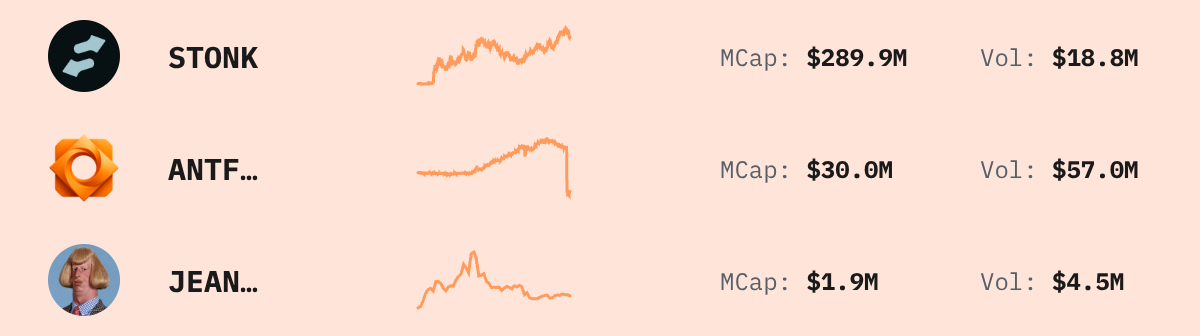
Among newly launched tokens on Solana, RuneScape Gold is perhaps the most attention-grabbing by name — an apparent attempt to bridge nostalgia for the classic MMORPG's in-game economy with on-chain speculation. CLIPBACK and Super Inu also appear in the new listings. New Solana token launches of this nature carry the full spectrum of risk typical of permissionless launchpad activity, and their longevity beyond initial listing is historically limited without sustained community engagement.
Outlook
Today's session is defined less by price action and more by structural regulatory and institutional developments. The SEC's conditional green light for tokenized stocks, combined with Commissioner Peirce's support for autonomous DeFi systems, marks a potentially pivotal moment for the industry's compliance trajectory. S&P Global's OpenZeppelin acquisition adds further weight to the narrative that institutional capital is now buying into blockchain infrastructure directly. The coming weeks will likely see significant commentary and positioning around these themes — particularly as the Uniswap v4 permissioned pool framework moves closer to practical implementation in the US market.