Bitget Suffers a Major Security Breach
The most significant story shaking the crypto space this week is the confirmed hack of Bitget, with onchain data pointing to losses exceeding $100 million. The incident, which surfaced on September 25, sent immediate shockwaves through the industry — yet another high-profile exchange breach adding to a long and costly history of hot wallet compromises.
A Bitget representative moved quickly to contain the damage narratively, confirming that wallets are now back under control and that the breach was largely limited to hot wallets. Cold wallet storage was reportedly unaffected. The exchange also stated that its Bitget Protection Fund is sufficient to cover the losses, a claim that will be closely scrutinized by users and analysts in the days ahead. Protection funds have been tested before across the industry, and their actual depth is often only verified under pressure. Whether Bitget's fund holds up to that scrutiny remains to be seen.
This incident is a stark reminder of the systemic risk that centralized hot wallets continue to pose. For context, even exchanges with mature security infrastructure remain high-value targets, and nine-figure losses in a single attack are no longer exceptional. Users holding significant balances on any centralized platform should consider this an ongoing structural risk.
The Federal Reserve Opens Stablecoin Rulemaking Under the GENIUS Act
In a move with potentially far-reaching consequences for the stablecoin market, the Federal Reserve Board has formally requested public comment on two proposals aimed at establishing a regulatory framework for payment stablecoin issuers under the GENIUS Act. This applies specifically to issuers supervised by the Fed itself.
The GENIUS Act, which has been working its way through U.S. legislative channels, represents one of the most concrete attempts to bring dollar-pegged stablecoins under a defined federal regulatory umbrella. The Fed's move to open a public comment period signals that implementation is progressing from legislation to active rulemaking — a meaningful step forward.
For the broader market, this is significant. Clarity around stablecoin issuance requirements — reserve standards, audit obligations, permissible issuers — has been one of the most requested items from institutional participants. Tether and Circle, the two dominant stablecoin operators by market cap, will be watching this process carefully, as the framework could reshape competitive dynamics depending on what compliance obligations are introduced for Fed-supervised entities versus those operating outside that structure.
Binance Alpha Lists GSTOCK
On the listings front, Binance Alpha has added Gstock (GSTOCK), a BSC-based token, to its platform. At the time of the announcement, the token carried a market cap of approximately $20.9M to $21.1M across its tracked pairs. It's worth noting that Binance Alpha listings do not guarantee an official Binance exchange listing — the Alpha platform serves as an earlier-stage discovery layer rather than a confirmed promotion pathway.
GSTOCK's relatively modest market cap means it occupies speculative territory, and traders should approach with appropriate caution around liquidity and volatility typical of early-stage BSC tokens.
Chain-Level Trends Worth Watching
Across the major chains, several tokens are drawing attention in trending lists this week. On Ethereum, Quant is showing up in trending activity alongside NEAR. On Base, Aerodrome continues to attract interest, consistent with its position as the leading DEX on that network. On BNB Smart Chain, ARK is trending alongside newer names like Quack AI Token and Rhea.
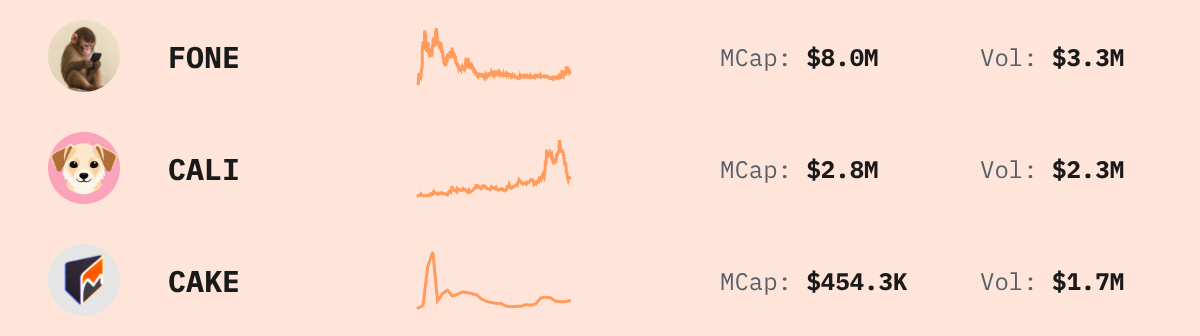
On Solana, the new token launches continue at pace, with JACK and insta.fan among the freshest additions. As has been the pattern through 2026, Solana remains the most active chain for new token issuance, with the majority of launches remaining highly speculative and short-lived in terms of sustained volume.
Outlook
The dominant narrative heading into the final days of September is the Bitget hack and its aftermath. Markets will be watching closely to see whether the Protection Fund claim holds up and how user withdrawals respond over the next 48 to 72 hours — exchange hacks historically create localized contagion risk if confidence erodes quickly. Simultaneously, the Fed's stablecoin rulemaking process is a slow-burn development that will shape regulatory expectations well into 2027. Taken together, both stories reinforce two persistent themes in this market: security remains a critical vulnerability at centralized venues, and the regulatory scaffolding around digital assets is being constructed in real time.