Citi Partners With Coinbase to Bring Stablecoin Payments to Institutional Clients
One of the most significant developments to surface this week is the reported partnership between Citibank and Coinbase, enabling stablecoin payments for institutional clients. According to reporting from the Wall Street Journal, cited by Bloomberg, the collaboration marks another step in traditional financial institutions embedding crypto infrastructure into their core operations. While details on the specific stablecoins and settlement rails involved remain limited, the partnership signals that institutional demand for programmable, blockchain-based payments continues to grow. Citi joining the list of major banks actively integrating crypto payment rails — rather than simply offering custody or ETF exposure — is a meaningful shift worth watching.
MetaMask Responds to Security Incident — Wallets Said to Be Unaffected
MetaMask issued a statement on October 1st confirming it is responding to a security incident involving validators. Importantly, the team stated that MetaMask wallets themselves are not under threat, and the project has begun exiting affected validators as a precautionary measure. The incident serves as a reminder of the ongoing operational risks in decentralised infrastructure, even for well-established protocols. Users holding assets in MetaMask wallets were told there is no immediate threat, though the situation was still developing as of the announcement. Anyone using MetaMask-connected validator services should monitor official channels closely for further updates.
CASHCAT Lists on Upbit Across KRW, BTC, and USDT Markets
Korean exchange Upbit has added CASHCAT (CASHCAT) to its platform, opening trading across KRW, BTC, and USDT pairs. At the time of the listing announcement, CASHCAT carried a market capitalisation of approximately $166.8 million. Upbit listings are historically significant for tokens targeting Korean retail demand, given the exchange's substantial trading volumes and the well-documented "Kimchi premium" effect that can accompany new listings. Traders should be aware that newly listed tokens on high-volume exchanges often experience short-term volatility as liquidity is established and price discovery plays out.
Binance Futures Expands TradFi Perpetual Contracts — and Culls Others
Binance Futures made two notable announcements in close succession. On September 29th, the exchange confirmed it would launch multiple new TradFi USDⓈ-margined perpetual contracts, reflecting continued appetite for bridging traditional financial instruments with crypto derivatives markets. However, on October 1st, Binance also announced it would delist multiple USDⓈ-M perpetual contracts on October 5th. The simultaneous expansion and contraction of the derivatives offering suggests Binance is actively rebalancing its perpetuals roster — removing lower-liquidity pairs while introducing contracts tied to traditional finance assets. Traders holding positions in any of the affected contracts should verify whether their specific instruments are on the delisting list ahead of the October 5th deadline.
Trending Tokens: A Mixed Bag Across Chains
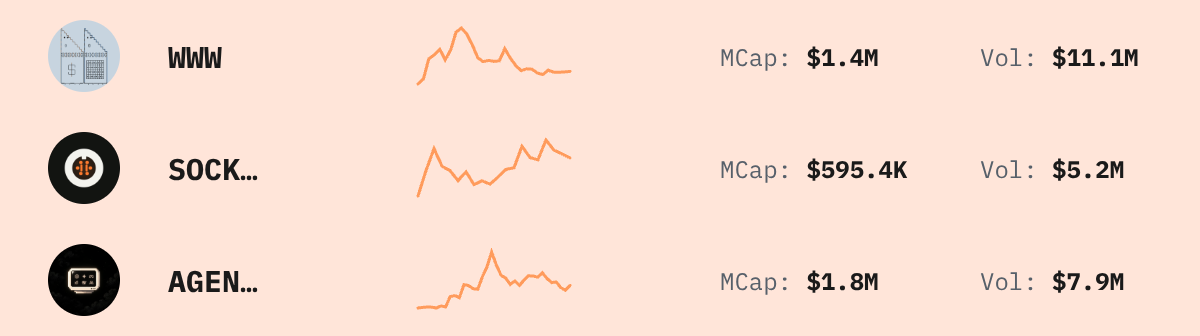
Across the major chains, several tokens are drawing attention in on-chain activity. On Solana, newly launched tokens including world wide web, Socket, and Agency are appearing in trending lists, though volume data remains nascent. On Ethereum, Quant, Fake World Assets, and Pepe are seeing renewed interest, with Pepe in particular continuing its pattern of periodic resurgence among memecoin-oriented traders. On Base, Doppler Finance and Venice Token are generating early-stage attention, while BNB Smart Chain is seeing activity around MarsCoin and Concrete. It is worth noting that many of these are early-stage or memecoin-adjacent tokens — volume data is minimal and should be treated with appropriate caution.
Prediction Markets: Fed Rates and Indiana Data Center Policy in Focus
On Polymarket, two macro-adjacent questions are drawing interest. The first asks whether the Federal Reserve will hold rates unchanged at its October 2026 meeting — a question with direct implications for risk asset appetite broadly. The second concerns whether Indiana will enact a data center moratorium by the end of 2027, a niche but increasingly relevant policy question as energy consumption debates around crypto mining and AI infrastructure heat up in US state legislatures. A third active market questions the probability of Anthropic announcing bankruptcy by December 31, 2027, reflecting broader market interest in the financial durability of large AI ventures.
Outlook
The week's most durable story is likely the Citi-Coinbase stablecoin partnership, which adds institutional weight to the narrative that stablecoins are becoming a mainstream settlement layer. The MetaMask security incident warrants continued monitoring, though the immediate wallet-level risk appears contained. With Binance reshaping its derivatives offering and Upbit adding new listings, the market infrastructure layer remains active even in the absence of dramatic price action. Heading into the first full week of October, macro factors — particularly Fed rate expectations — will continue to set the broader tone for crypto risk appetite.