PYTH DAO Votes to Redirect All Revenue to Token Buybacks
One of the more structurally significant governance decisions in recent memory came from the Pyth Network this week. The PYTH DAO has approved what it calls the "100% Rule", a framework that directs the entirety of protocol product revenue toward open-market PYTH token buybacks. This marks a meaningful shift from the previous model, under which only one-third of revenue was allocated to buybacks. With the network reporting growing revenue, the threefold increase in buyback pressure is worth watching closely. PYTH currently carries a market cap of approximately $595 million, and sustained open-market purchasing could have a tangible effect on circulating supply dynamics over time.
Coinbase Adds Support for Whuffie (WHUF)
Coinbase announced it will be adding support for Whuffie (WHUF), enabling deposit address generation across Coinbase.com, the Coinbase mobile app, and Coinbase Exchange in supported regions. The listing comes with a notable caveat: deposits will remain unavailable until the asset issuer unlocks transfers, meaning active trading is not yet live. WHUF also appeared as a new token on Base, making it one of the few assets this cycle to debut simultaneously on a major L2 and receive a top-tier exchange listing in the same window. The timing suggests a coordinated rollout, though the mechanics of the transfer unlock will be key to watch.
PONS Hits Both Upbit and Bithumb Simultaneously
Korean exchange activity was notable on October 8th, with PONS securing listings on both Upbit and Bithumb within roughly 20 minutes of each other. Upbit opened KRW, BTC, and USDT trading pairs, while Bithumb followed with a KRW market addition. PONS carries a reported market cap of $262.9 million, putting it in a meaningful size bracket for a fresh listing. Dual Korean exchange listings often generate significant short-term volume given the historically strong retail participation on both platforms, and the near-simultaneous nature of this rollout suggests coordinated exchange relations on the project's part.
Bithumb Also Welcomes CASHCAT and AIA
Alongside the PONS listing, Bithumb added KRW trading pairs for two additional tokens: CASHCAT and AIA. CASHCAT comes in with a market cap of $123.5 million, while AIA is considerably smaller at $22.5 million. The contrast in size between the two is worth noting — smaller-cap listings on major Korean exchanges can see outsized volatility in the early trading period as local liquidity discovers price. Whether either token sustains momentum beyond the listing bounce will depend heavily on underlying fundamentals and community engagement in the Korean market.
Trending Tokens Across Chains: A Mixed Picture
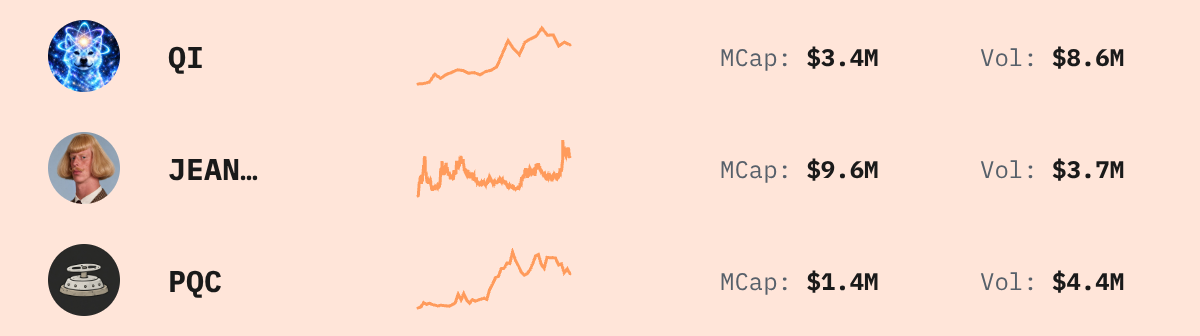
Across the major chains, a handful of tokens are generating early attention. On Solana, Quantum Inu and pqc.market are both appearing as new and trending simultaneously — the "pqc" branding is likely a nod to post-quantum cryptography, a theme that has gained cultural traction in crypto circles as quantum computing discourse heats up. On Base, Doppler Finance and Aerodrome continue to draw attention, with Aerodrome being one of the more established DeFi protocols on the chain. On Ethereum, tokens with names like Bunker Mode and zipcoin are trending, though with negligible recorded volume at this stage. On BNB Smart Chain, TartSwap and AEON are seeing early activity. These are broadly speculative early-stage tokens, and low volume figures reflect that most are still in price discovery.
NFT and Ordinals Activity
On the collectibles side, Courtyard.io, CryptoPunks, and Pudgy Penguins remain the top NFT collections by volume ranking, holding their positions as the market's most consistently traded blue-chip assets. In the Bitcoin Ordinals space, Full Moon Ordinals and Fukuhedrons continue to appear among the top collections by volume, reflecting ongoing niche interest in the Ordinals ecosystem despite a broader quieting of the initial inscription frenzy seen in earlier cycles.
Outlook
The dominant narratives heading into the rest of the week center on exchange listings and protocol governance rather than broad price action. The PYTH buyback expansion is the most structurally interesting development — if revenue continues to grow, the compounding effect of full buyback allocation could become a meaningful supply-side factor. The wave of Korean exchange listings for PONS, CASHCAT, and AIA adds short-term speculative interest to watch. Meanwhile, the post-quantum branding emerging on Solana with tokens like pqc.market hints at a thematic narrative beginning to take shape, one that could attract more capital if the broader quantum computing conversation intensifies in mainstream tech media.