The Biggest Exchange Hack in Crypto History
The crypto world woke up this week to what appears to be the largest exchange exploit ever recorded. On-chain data confirms that approximately $6.26 billion in assets were drained from Binance wallets and moved to attacker-controlled addresses spanning nine separate blockchains — including Ethereum, Bitcoin, Tron, XRP, Solana, Arbitrum, Avalanche, Optimism, and Base. To put that number in context, it dwarfs previous major exchange incidents, including the 2022 FTX collapse and the 2014 Mt. Gox breach.
The breadth of the attack is particularly striking. Moving funds across nine chains simultaneously suggests either a highly sophisticated, coordinated operation or a compromise at a deep infrastructure level — potentially affecting private key management or internal signing systems. The cross-chain nature of the outflows also significantly complicates asset freezing and recovery efforts.
Aave Steps In to Limit Contagion
One of the most consequential immediate responses came not from a regulator or law enforcement agency, but from a DeFi protocol. Aave froze its lending markets shortly after the exploit was identified on-chain, citing the risk that the attacker could use stolen assets as collateral to borrow against Aave's liquidity pools. This is a well-documented attack vector in DeFi: a bad actor dumps large quantities of stolen tokens into a lending protocol, borrows stablecoins or other assets against them, then disappears — leaving the protocol holding depreciating or frozen collateral.
Aave's market cap sits at approximately $2.1 billion, making this a material risk management decision for the protocol. The freeze was executed on-chain, reflecting the governance and guardian mechanisms that major DeFi protocols have developed in response to previous exploit scenarios. How long those markets remain frozen — and what governance process governs their reopening — will be closely watched by the DeFi community.
Law Enforcement Enters the Picture
According to a Reuters report, Binance is now cooperating with both the FBI and the U.S. Secret Service in the aftermath of the $6.3 billion theft. This marks a significant escalation beyond the typical on-chain community response, bringing federal resources into what is now effectively a major financial crime investigation.
The involvement of the Secret Service is notable — the agency has a dedicated cybercrime division with experience in large-scale financial fraud cases. However, the cross-jurisdictional nature of the funds movement, spanning multiple chains and likely multiple legal territories, means recovery remains highly uncertain.
CFTC Sees a Regulatory Opening
CFTC Chairman Michael Selig used the incident to make a pointed public statement in a CNBC interview, calling for crypto exchanges to register with the CFTC. "We want to offer a federal option to these exchanges to come and register with the CFTC," Selig said, framing the hack as evidence of the need for clearer federal oversight frameworks. The comment lands in a long-running debate over whether the SEC or CFTC should hold primary jurisdiction over crypto markets — a question that remains unresolved even as incidents of this scale unfold.
Notably, Binance also announced that the planned listing of Predict (PREDICT) on Binance has been postponed, an unsurprising operational decision given the circumstances but one that signals the exchange is in crisis management mode rather than business-as-usual operation.
Trending Tokens Reflect the Chaos
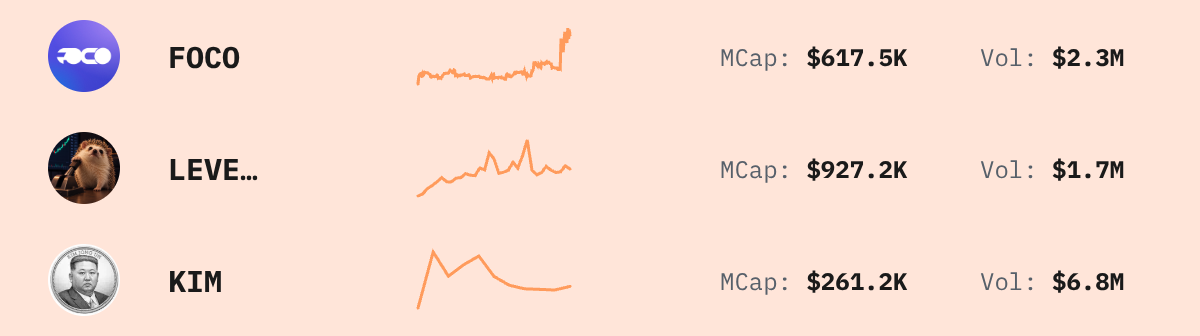
Across on-chain markets, trending tokens on Solana, Base, Ethereum, and BNB Smart Chain include names like Kim Jong Un Coin, GTA VI, Quack AI Token, and Infinity Ground AI — a mix of political meme tokens and AI-themed projects that tends to emerge during periods of market uncertainty when speculative attention fragments. New Solana launches include Leverhedge and Apple Cat, with volumes negligible at this stage. None of these appear directly connected to the Binance situation, but the meme token activity is consistent with retail participants seeking distraction or quick trades during a news-heavy cycle.
Outlook
The Binance hack will define the next several weeks of crypto market structure discussion. Key variables to watch include whether any of the stolen funds are successfully frozen by stablecoin issuers or bridge operators, how Binance communicates its solvency position and user fund protection measures, and whether this incident accelerates regulatory action at the federal level. Aave's re-opening of lending markets — and on what terms — will also serve as an early signal of how DeFi protocols adapt their risk frameworks in the aftermath. For now, the situation remains fluid and the full scale of the damage is still being assessed on-chain.