The Binance Heist Dominating Headlines
The story that has consumed crypto news cycles this week centres on a significant security breach at Binance. According to reporting from Reuters, hackers used a bogus job interview to compromise an employee's computer, ultimately gaining access to internal systems and stealing cryptocurrency. The attack vector — a fake recruitment process used to deliver malware — is a well-documented tactic increasingly favoured by sophisticated threat actors targeting the industry.
What makes this incident particularly notable is the method of escalation. Binance confirmed that the attacker leveraged the compromised machine to access an internal AI tool, which was then used to gain control over wallets. The use of internal tooling to pivot deeper into infrastructure marks a troubling evolution in exchange-level attacks, moving beyond simple credential theft toward exploiting trusted internal systems.
North Korea Pushes Back
Fingers were quickly pointed at North Korean state-sponsored actors — a familiar accusation given the regime's well-documented history of crypto theft to fund its operations. However, Pyongyang has formally denied any involvement, with state news agency KCNA calling the claims an outright "fabrication," according to Reuters. North Korean denials are routine following attribution of major crypto heists, so the pushback alone carries limited evidentiary weight. Blockchain forensics firms and investigative journalists are likely continuing to trace fund flows, which historically provides more reliable attribution than official statements from either side.
GitBook Discloses Separate Security Breach
Compounding a difficult week for crypto-adjacent infrastructure, documentation platform GitBook disclosed a security breach on November 2nd, attributing it to what it described as "sophisticated AI agents." In response, GitBook revoked all personal API tokens site-wide and urged users to immediately rotate their secrets. While GitBook is not a crypto-native platform, it is widely used by blockchain projects and developer teams to host technical documentation — making any compromise of its systems a potential supply-chain risk for the broader ecosystem. Teams relying on GitBook for sensitive internal documentation should treat this as a priority action item.
French Bank Credit Mutuel Arkéa Loses $130M
On-chain investigator ZachXBT identified the entity behind a separate $130 million hack as Credit Mutuel Arkéa, a French banking institution managing approximately $235 billion in assets under management. The scale of the loss — and the profile of the victim — underscores that institutional exposure to crypto custody and digital asset infrastructure is not without meaningful operational risk. Details on the exact exploit vector remain sparse, but ZachXBT's identification of the entity adds a significant institutional dimension to what might otherwise have been an anonymous on-chain theft. It also raises questions about regulatory scrutiny of how traditional financial institutions are managing their crypto-side operations and custody arrangements.
Trending Tokens: Memes, AI, and Cultural References
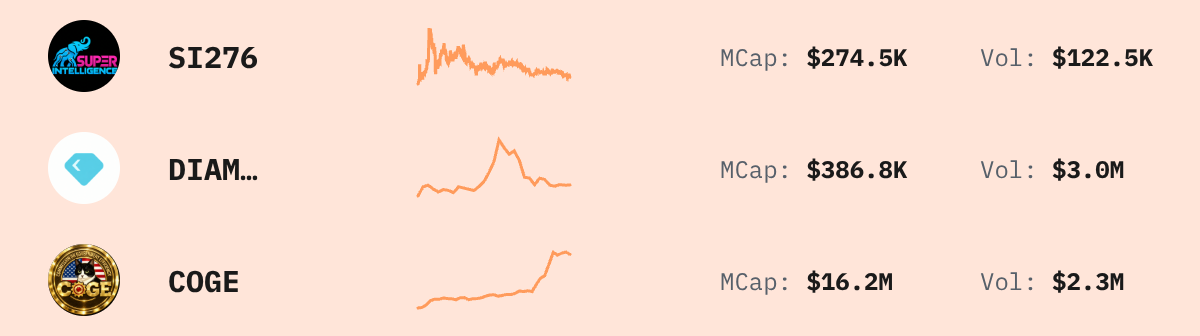
Across the major chains, trending tokens this week reflect the usual mix of speculative meme plays and culturally timed launches. On Ethereum, a token named GTA VI has been circulating alongside the perennial Pepe, likely riding anticipation around the game's release timeline. On BNB Smart Chain, UnifAI is attracting attention in the AI-narrative space. Base is seeing activity around Impossible Cloud Network Token, which carries a more infrastructure-focused framing compared to the typical memecoin fare. On Solana, newer launches including Diamond Hands and COGE COIN have appeared, though volume data across all trending tokens remains negligible at this stage — a reminder that trending does not equate to liquidity or longevity.
Outlook
The defining theme of this period is security. Three significant breach disclosures in the span of a few days — Binance, GitBook, and Credit Mutuel Arkéa — signal that threat actors are becoming more sophisticated in their targeting of both crypto-native firms and the institutions increasingly adjacent to them. The use of social engineering via fake job interviews and the leveraging of internal AI tooling represent a maturation in attack methodology that the industry will need to address structurally. With North Korea's denial unlikely to settle the attribution debate, and on-chain forensics ongoing, expect this story to develop further in the coming days. For projects and teams, this week serves as a timely reminder to audit access controls, rotate credentials, and scrutinise third-party tooling dependencies.